
Flow Injection Analysis vs. Segmented-Flow
Why Many Labs Choose Bubble-Free Flow Injection for Automated Wet Chemistry
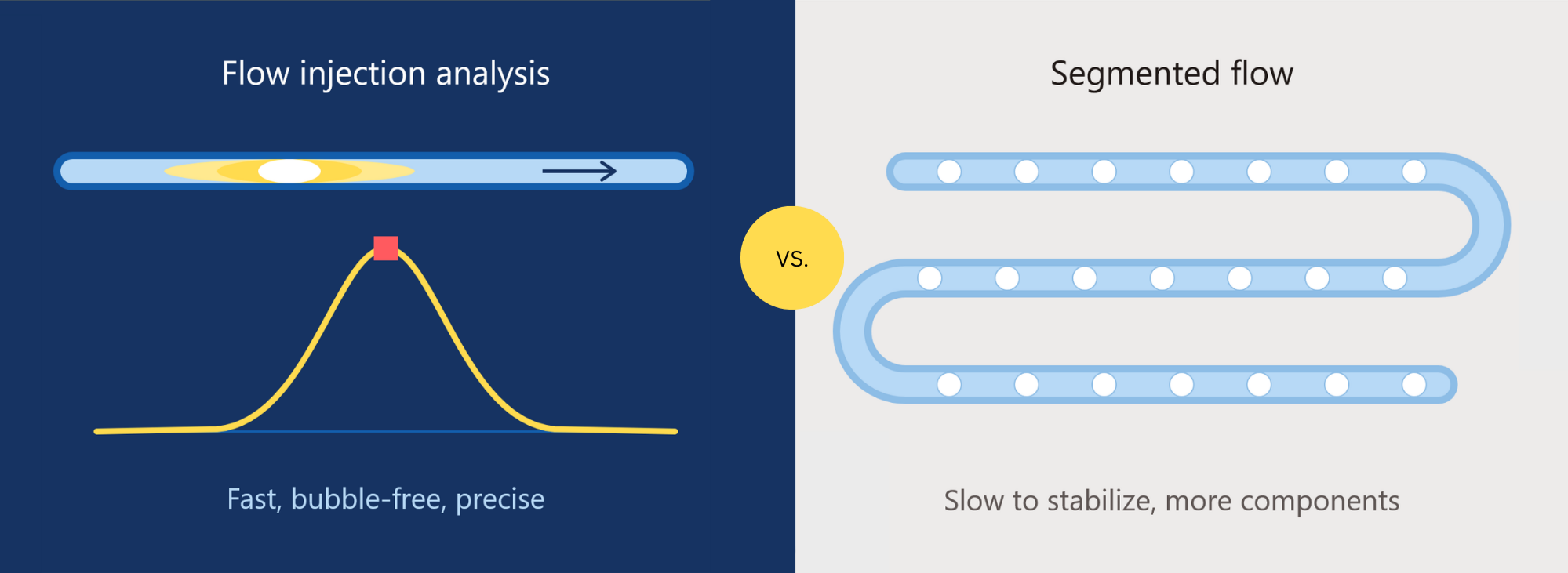
Flow Injection Analysis (FIA) and Segmented Flow Analysis (SFA) are both continuous flow techniques that automate colorimetric wet chemistry assays, such as ammonia, nitrate/nitrite, phosphate, cyanide, and other routine methods. SFA, developed by Leonard Skeggs in the 1950s, uses air bubbles to separate samples being introduced into the system. FIA, introduced by Růžička and Hansen in the 1970s, replaced air bubbles with an injection valve, which delivers a precise volume of each sample into an unsegmented stream so that dispersion is controlled and reproducible from one sample to the next.
Both techniques are well established and accepted for regulatory testing. FIA methods are approved for use under US EPA regulations (40 CFR Part 136, Part 141), and published in Standard Methods (4500 series), ISO, and ASTM. The differences show up in day-to-day operation: how fast you get results, how much time goes into startup and changeover, and the ease of use, troubleshooting, and maintenance.
How the Two Techniques Work
Segmented Flow Analysis (SFA)
Samples, reagents, and air are pumped continuously through the system; the air enters the stream as evenly spaced bubbles, often dependent on the pump's roller motion, which divide the flow into small segments. The bubbles limit sample dispersion, promote mixing within each segment, and scrub the tubing walls. The reaction is typically allowed to approach completion, or "steady state," in mixing coils, and the bubbles must be removed or electronically filtered out before the reading.
Flow Injection Analysis (FIA)
A precisely metered sample volume is injected into the liquid carrier stream, where it then merges with reagents in the manifold’s mixing and reaction coils on its way to the detector. As the sample slug travels, it disperses in a controlled and highly reproducible way. Because every standard and sample experiences the same injection volume, timing, and dispersion, the reading can be taken before the reaction reaches completion and still be accurate and repeatable. This reliance on automated and robust timing, rather than air segmentation and steady state, is the key structural difference between the two techniques.
Conceptually, FIA is similar to HPLC: a precise injection into a moving stream, measured as a peak, but without the column or the high pressure.
The Benefits of Flow Injection Analysis
In automated wet chemistry, speed, reliability, precision, and ease of operation drive laboratory productivity. The textbook Principles of Instrumental Analysis (Skoog, Holler, and Crouch) lists four main advantages of flow injection over segmented flow: higher analysis rates, faster response times, much faster startup and shutdown, and simpler, more flexible equipment. In practice, those translate into:
Higher Sample Throughput: FIA can process samples rapidly and continuously; because sample slugs need no air segments, injections can be spaced closely and more samples run per hour.
Fast Startup, Calibration, and QC Review: The speed of FIA allows calibrations and initial QCs to be completed shortly after the run start. The analyst can quickly confirm that everything passed, then move on to other tasks while the run continues unattended.
Enhanced Response Times: Because FIA relies on precise, reproducible timing rather than waiting for the reaction to reach completion, results come quickly. Many FIA methods produce a detector response well under a minute after injection, and methods can be configured for longer reaction times when the chemistry requires it.
No Bubbles to Manage: There is no air to introduce, regulate, or remove, which means fewer components in the flow path and no bubble-related noise in the baseline.
Analysis on the Fly: Because results appear within minutes of starting a run, problems surface early. A failing check standard or a reagent issue is caught while staff are on hand to fix it, before samples, reagents, and time are wasted.
Lower Reagent Use and Waste: Small injection volumes and optimized method timing reduce chemical cost and waste disposal.
Simpler, More Flexible Equipment: FIA’s straightforward design means fewer moving parts and fewer potential points of failure. Modular components can be serviced or swapped individually, so a single issue doesn’t have to take the whole system down, keeping your lab running.
Does Going Bubble-Free Sacrifice Sensitivity?
A common misconception when moving from SFA to FIA is that eliminating air segmentation compromises analytical performance. To see why it doesn't, it helps to look at what "sensitivity" actually means.
Sensitivity is a method’s ability to identify small differences in analyte concentrations. Two factors limit it: the slope of the calibration curve (how much signal you get per unit of concentration) and the precision of the measurement (how repeatable that signal is).
In SFA, letting the color fully develop at steady state can raise the signal per unit concentration, especially for slow reactions, at the cost of several minutes per sample. In FIA, the sample slug is partly diluted by dispersion and is often read before the reaction is complete, so for some chemistries the slope can be lower. FIA makes up for it with precision: injection volume, timing, and dispersion repeat identically for every sample, and there is no bubble interface adding detector noise. Because standards and samples are treated identically, reading before completion does not bias the result, and routine QC such as matrix spikes and continuing calibration checks confirms this for each sample type.
Where low limits are needed, the sample loop volume and flow cell path length are tuned to increase the response. This allows FIA methods to routinely meet the reporting limits required for regulatory nutrient and inorganic testing. The table below shows typical MDLs achieved on FIAlab systems for common regulatory methods.
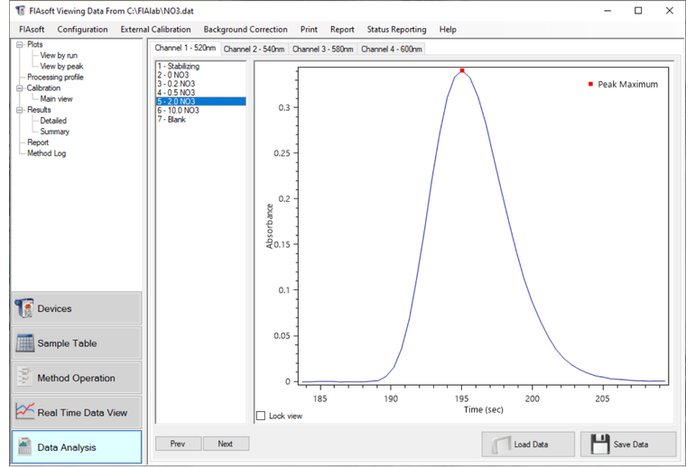
Figure 1: FIAsoft peak for a nitrate calibration standard. The software identifies the peak maximum (red square) and can quantify by peak height or peak area. This injection was read in about 25 seconds.
*Instead of traditional phenate/salicylate colorimetric measurement, FIAlab offers an EPA-approved fluorometric method for ammonia and TKN.
**For post-distillation total cyanide. MDL with In-line UV Digestion (ISO 14403 and ASTM D7511) are 0.001 mg/L CN.
MDLs determined per 40 CFR Part 136, Appendix B (Rev. 2) in reagent water on a FIAlyzer with low-noise detector. Actual MDLs may vary by matrix, configuration, and lab.
See our complete Methods List or reach out to a FIAlab representative with any questions.
| Analyte (reported as) | MDL (mg/L) | Method Reference |
|---|---|---|
| Ammonia (NH3-N) | 0.003 | EPA 350.1, SM 4500-NH3 H |
| Ammonia (NH3-N) | 0.001 | EPA FIAlab100 |
| Nitrate+Nitrite (NO3-N) | 0.0001 | EPA 353.2, SM 4500-NO3 F |
| Nitrite (NO2-N) | 0.0001 | EPA 353.2, SM 4500-NO3 F |
| Orthophosphate (PO4-P) | 0.0004 | EPA 365.1, SM 4500-P F/G |
| Total Cyanide (CN)* | 0.0004 | EPA 335.4, SM 4500-CN N |
| Free/WAD/Available CN (CN) | 0.0005 | EPA OIA-1677, ASTM D7237 |
Not limited to fast reactions
FIA throughput depends on how often samples are injected, not on how long each one spends in the manifold. Several samples can travel through the manifold at once, so methods that need longer reaction times or heating can be accommodated without slowing the run in proportion.
Stable calibration through long runs
Reading before steady state does not mean frequent recalibration. A properly configured FIA system holds its calibration through long runs; some customers run hundreds of samples in a single analytical run. FIAsoft can also apply an existing calibration when more samples arrive later in the day, and calibration is regularly verified through FIAsoft's built-in QC monitoring of your CCV checks.
Your Partner in Analysis
FIAlab works with you on a complete solution for your sample measurement needs. That includes installation and training, comparison runs and initial MDL studies, and ongoing support and service whenever you need it.
See the Difference in Your Own Lab
SFA is a capable, well-proven technique, and switching is a big decision. If you're weighing a move to FIA, contact us to see a virtual demo, compare FIA with your current workflow, or get references from labs near you that run FIAlab systems.